Smart Film & Switchable Glass
Clear when you want the view. Private when you don’t.
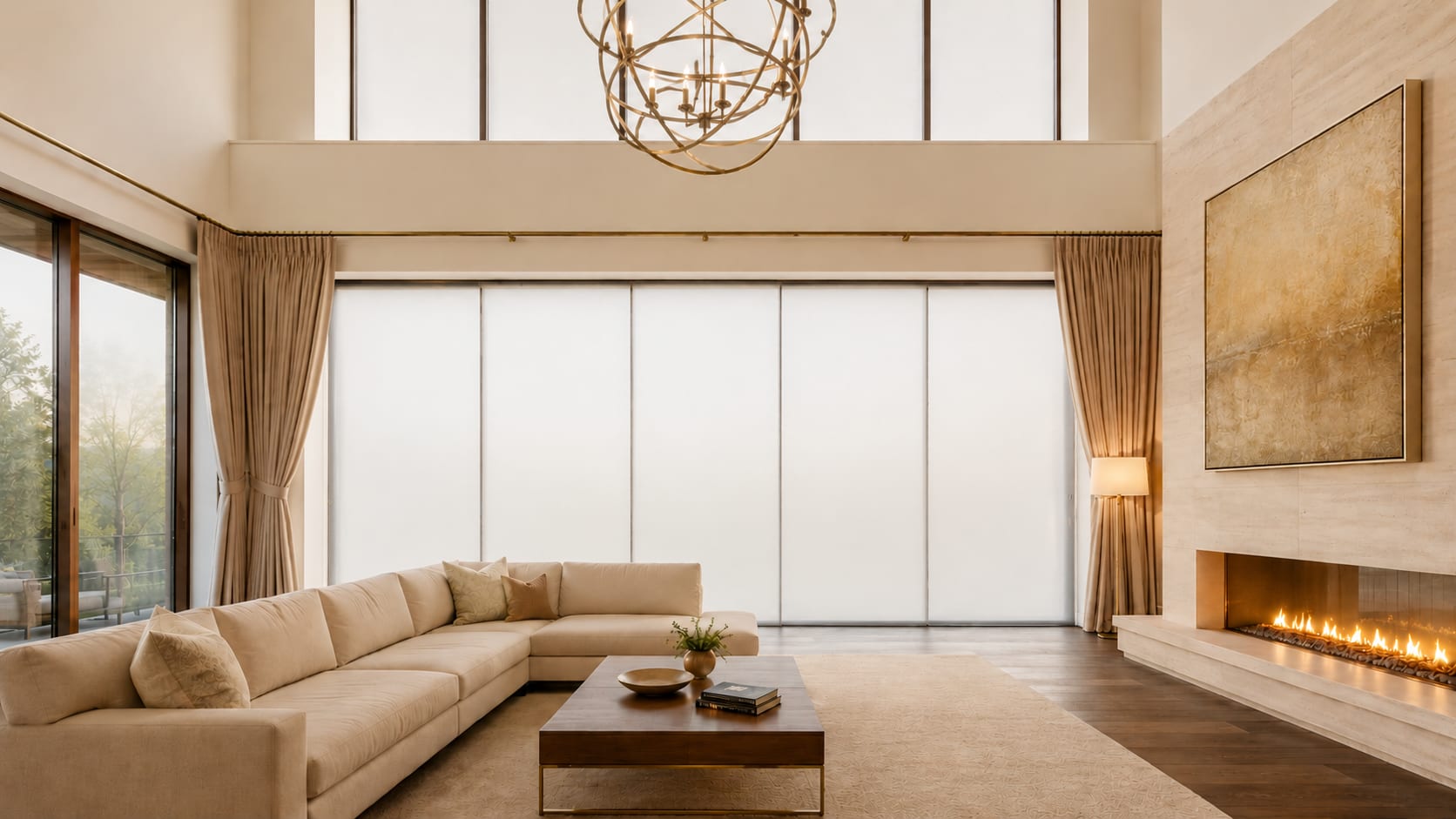
Switchable glass does something no shade can: it changes the glass itself. Powered on, the panel is transparent and the view is uninterrupted. Powered off, it turns to a soft white frost that blocks sight lines completely while still carrying daylight into the room.
The effect is instant and silent. There is no fabric, no hardware, no stack of material sitting at the top of the opening — which is exactly why it suits the kind of architecture that was designed around its glass in the first place.
How it works
The technology is PDLC — polymer dispersed liquid crystal. A liquid crystal layer is suspended between two conductive films. With no power applied the crystals sit at random angles and scatter light, so the panel reads as frosted. Apply low-voltage current, the crystals align, and the panel turns clear.
Because the switching is electrical rather than mechanical, there is nothing to wear out the way a motor or a lift cord eventually does. Power is drawn only while the panel is held clear.
The consequence of that mechanism is the thing most people are not told: PDLC scatters light, it does not absorb it. Frosted, a panel still passes a large share of the daylight reaching it — most of it arrives as diffused rather than directional light. You lose the sight line and keep the brightness.
Which is exactly why PDLC delivers privacy and not darkness. For a room that has to go genuinely dark, the answer is a blackout shade in side channels, not glass.
Three finishes, and they do not behave the same
PDLC is supplied in frosted white, gray, and black or charcoal. The choice is not purely cosmetic.
Frosted white is the classic and the one most people picture. It is the brightest of the three and the most neutral against white trim and plaster.
Gray and black/charcoal are tinted films. They read as a darker panel when switched off, and because the tint absorbs some light rather than only scattering it, they cut noticeably more glare and more solar heat than white film does. They also do not return to perfectly clear when powered — a slight tint remains in the on state.
If heat rather than privacy is the actual complaint, this distinction matters. Standard white PDLC has very little effect on solar heat gain. A tinted film helps, and DLC — the fully dyed black version — helps considerably more.
PDLC or DLC — which one your room wants
We supply both, and they get conflated constantly. They switch the same way. The difference is in the physics of the off state, and it decides what each one is good for.
PDLC scatters light. Off, the panel is private but the room stays bright, because most of the daylight still arrives — just diffused.
DLC — dyed liquid crystal — absorbs it. Dye is carried within the liquid crystal layer, so switching off does not merely scramble the light, it removes it. That is why DLC can take out the overwhelming majority of incoming light where PDLC blocks very little. Powered on, DLC returns to see-through with a light black tint rather than going fully clear.
So the real question is whether you want privacy while keeping a room bright, or privacy that also cuts light, glare and solar heat. Bathrooms and interior partitions usually want the first. West-facing glass and media rooms usually want the second — see DLC dark smart film.
Where it earns its place
Primary baths and ensuites, where a window with a good view is also a window with a privacy problem.
Interior partitions between a study and a living space — open and connected when you want it, closed off for a call or a quiet hour.
Street-facing glass on tight lots, which is common in Pittsburgh’s older neighborhoods where houses sit close to the sidewalk.
Wine rooms, shower enclosures, and stair walls, where the glass is meant to be architectural rather than merely functional.
New glass or retrofit
There are two ways to get there. Laminated switchable glass is manufactured as a complete insulated unit and set into the opening, which produces the cleanest result and the best long-term durability. It suits new construction and full window replacement.
Retrofit film is applied to the interior face of glass you already own. It is the practical route when replacing the glass is not on the table, and it can be done room by room rather than all at once.
Which one makes sense depends on the opening, the existing glazing, and whether the wall is already open. We will tell you plainly which one your project calls for.
Control
A wall switch is the simplest option and the one most people live with happily. Beyond that, the glass can be zoned so that separate panels switch independently, scheduled to frost automatically at dusk, or tied into a whole-home system alongside your motorized shades so a single scene handles the entire room.
Common questions
- Does smart film make a room dark?
- PDLC does not — frosted, it blocks sight lines but still transmits diffused daylight, like frosted bathroom glass. DLC does darken the room, and the darker grades block the overwhelming majority of the light when switched off. How dark depends on the grade specified, which we confirm against measured figures before quoting.
- What happens during a power outage?
- The glass returns to its frosted state, since frosted is the unpowered condition. You lose the view, not your privacy.
- How much power does it use?
- Very little, and only while held clear — switched off it draws nothing at all. Figures in the region of 6 to 15 watts per square metre are typical, which is roughly one watt per square foot, comparable to LED lighting over the same area.
- Can it go on a window I already have?
- Often yes, using retrofit film applied to the interior surface. The existing glass needs to be in sound condition and reasonably flat. We assess this on site before quoting.
Talk to us about your windows
Free in-home consultation. We bring the samples to you, measure properly, and quote in writing.