Blackout & Room Darkening Shades
The fabric gets you room darkening. The channels get you blackout.
These two terms get used interchangeably and they are not the same thing. A blackout fabric hung as an ordinary shade gives you room darkening — a significantly dimmer room, but not a dark one. Blackout is what you get when the opening is sealed as well.
The reason is simple once you see it. The fabric stops light passing through the middle of the shade, but light was never coming through the middle of the shade. It comes around the edges, over the top of the roll, and under the hem.
So the specification that matters is not which fabric you choose. It is whether the system closes those three paths.
Room darkening, and what it actually gets you
A blackout fabric on a standard roller, mounted in the usual way, is a room darkening installation. It will take a bright bedroom down to comfortably dim. You will not be woken by daylight hitting your face, and a television will read properly during the day.
What you will also have is a bright outline. Two vertical lines of light down the sides of the shade, a glow over the top of the roll, and a line along the sill. On a west elevation in July those edges are not subtle.
For a great many rooms that is genuinely enough, and it is the less expensive specification. It is worth being clear about which one you are buying rather than discovering the difference after installation.
Blackout, and what turns one into the other
Side channels are the component that does it. The shade runs inside an aluminium track on each side, so the fabric edge is captured and there is no gap for light to travel through. This is the single biggest difference between the two specifications.
A closed or recessed headbox stops light spilling over the top of the roll, which is otherwise a significant leak on any shade mounted outside the reveal.
A sill seal or bottom channel closes the last gap at the hem.
With all three, the room goes properly dark in daylight. The fabric is the same fabric in both cases — it is the sealing that changes the outcome.
Layering for a principal bedroom
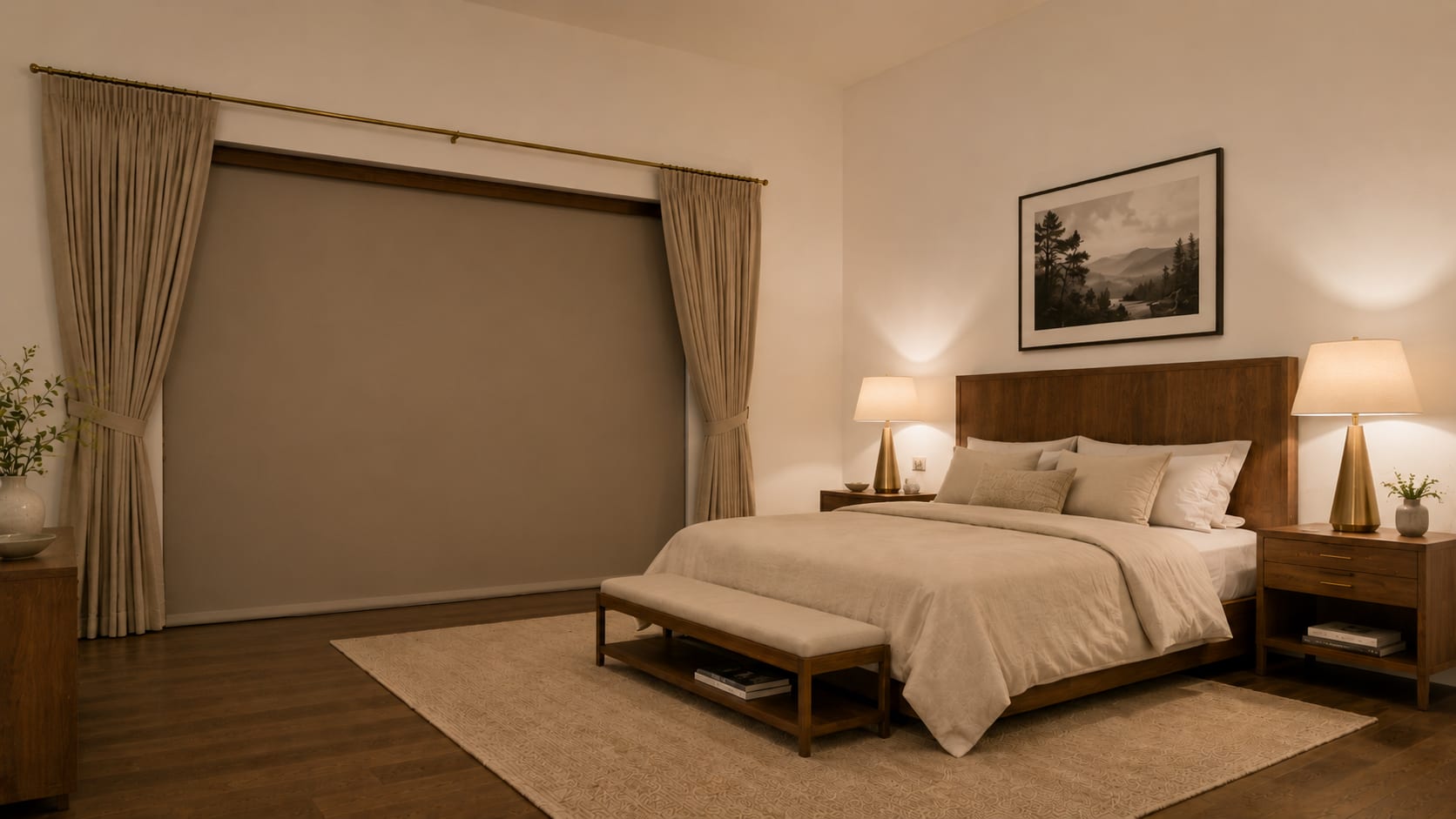
The arrangement that works, in order from the glass inward: a blackout roller shade in side channels doing the actual work, then drapery over it for warmth, acoustics and appearance.
Motorize both and put them on a single scene. A bedroom that darkens on a schedule and opens gradually in the morning is one of the few automation features people genuinely use every day rather than demonstrating once to guests.
Nurseries and shift workers
These are the two cases where partial darkness is not good enough, and where the difference between a shade with channels and a shade without it is the difference between a product that solved the problem and one that did not. We specify accordingly, and we would rather talk you into channels than have you call us back in a month.
Common questions
- Why does light still come in around my blackout shade?
- Because you have a room darkening installation rather than a blackout one. The fabric is doing its job; the edges are not sealed. Side channels, a closed headbox and a sill seal are what close those paths.
- What is the difference between room darkening and blackout?
- Room darkening is a blackout fabric on a conventional shade — a much dimmer room, with light still visible around the edges. Blackout adds side channels, a sealed headbox and a sill seal so the perimeter is closed. Same fabric; different system.
- Can a room be made completely dark?
- Effectively, yes — dark enough that you cannot read by the available light at midday. Bear in mind the shade only controls its own opening; light arriving under a door or from another window in the room has to be addressed separately.
- Will side channels ruin the look?
- They are slim and colour-matched, and in most installations they read as part of the reveal. In a bedroom where appearance is the priority, drapery over the top conceals them entirely.
Talk to us about your windows
Free in-home consultation. We bring the samples to you, measure properly, and quote in writing.