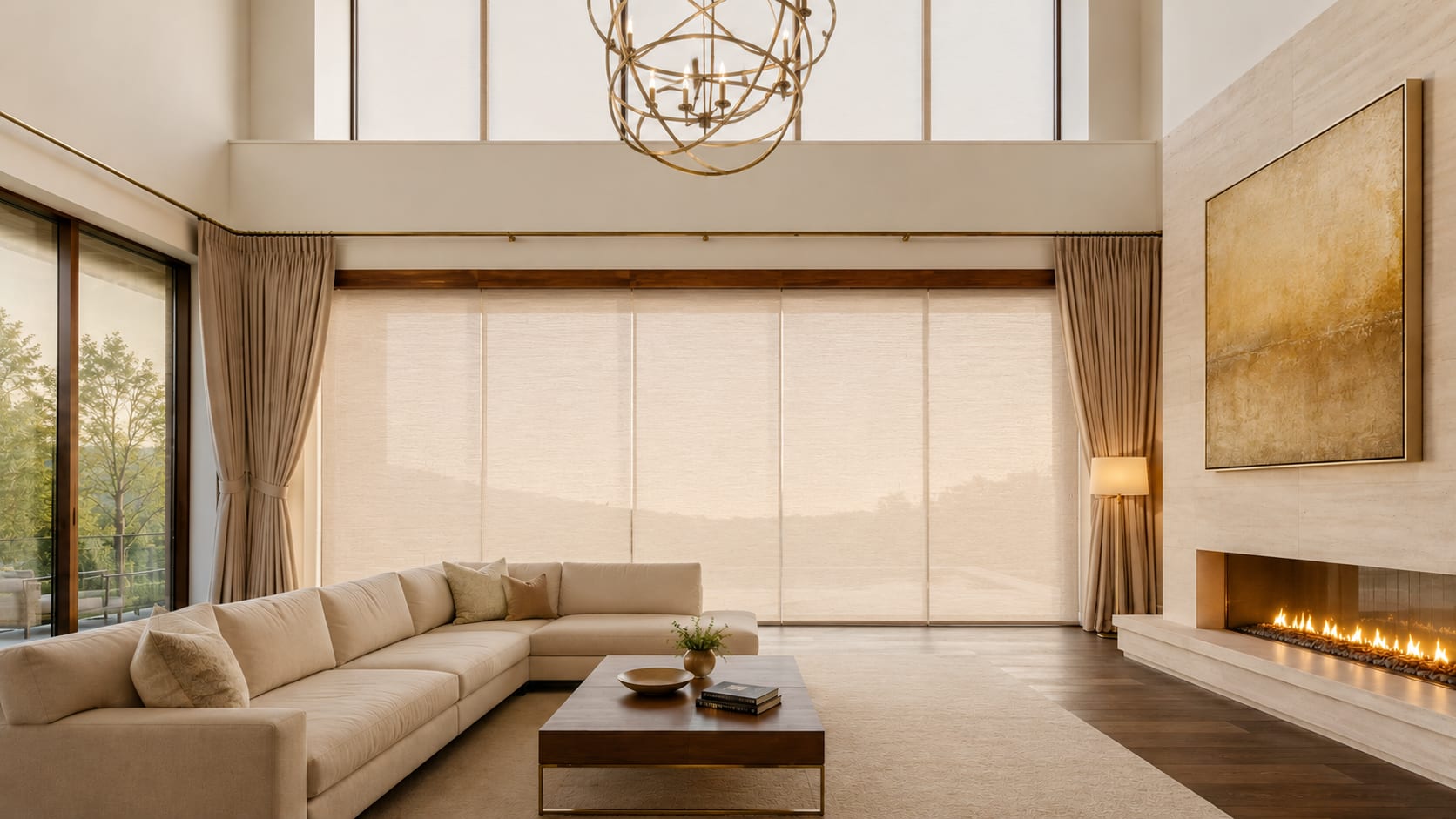
Motorized Shades
Every opening in the house, moving together.
Motorization stops being a novelty the moment a house has more windows than anyone wants to walk around and adjust. Two storeys of glass in a great room, a wall of sliders onto a terrace, a clerestory nobody can reach — these are the openings that simply do not get used manually, no matter how good the fabric is.
Done properly, the hardware disappears. The shade sits in a recessed pocket or a clean fascia, the motor is inaudible from a few feet away, and the whole house responds to one command.
Motors and power
Rechargeable lithium motors are the least invasive option. They mount without any electrical work, which makes them the right answer for a finished home where opening up walls is not welcome. The Rollease Acmeda Automate motors we specify carry a 12V lithium pack rated at roughly 500 up-and-down cycles per charge. On a shade that moves once a day that is around eighteen months; on one adjusted several times a day it is a few months. Cycles, not calendar time, are what actually govern it.
Hardwired motors are the better long-term choice in new construction or a full renovation, where we can get power to the head of the opening before the drywall goes up. They never need charging and handle the largest and heaviest shades without complaint.
Solar charging is a sensible middle path on bright exposures — a small panel keeps the battery topped up indefinitely.
Fabrics
Solar screen fabrics are specified by openness factor — the percentage of the weave that is actually open. A 1% screen has the tightest weave and works hardest against glare and heat; 5% is the usual choice for a living room, keeping more of the outlook at the cost of some glare control; 10% is for rooms where the view matters more than the sun does. On a west-facing Pittsburgh room, 1% or 3% is almost always the right answer, and the difference between that and a 5% is whether the room is usable at six in the evening.
Fabric colour matters as much as the openness number, and it catches people out. A dark charcoal or bronze screen absorbs light and gives a noticeably crisper view out with less glare — it is the better choice facing a screen or a view. A light or white screen reflects more heat at the glass but scatters light into the room, which can leave you with haze even at a tight openness. Choosing a pale fabric for a west window because it looks cooler is the most common specification mistake we correct.
Light-filtering fabrics soften daylight across the whole room without a defined view through. Blackout fabrics, paired with side channels, take a bedroom genuinely dark — see blackout and room darkening shades.
For a softer, more tailored look at the same automation, motorized Roman shades hold a folded profile rather than rolling onto a tube.
Control and scenes
A handheld remote or a wall keypad covers most of what a household actually needs. Beyond that, shades can be grouped so that an entire elevation moves as one, scheduled to track sunrise and sunset through the year, or driven by a sun sensor that drops the screens when the glare arrives and lifts them when it passes.
Through the Automate Pulse hub the shades join the major systems — Control4, Savant, Crestron, RTI — as well as the common voice assistants, so they sit inside the scenes you already use rather than adding one more app to the pile.
Measurement and installation
Motorized shades are unforgiving of sloppy measurement in a way manual shades are not: a tube that is out of level telegraphs across the full drop, and a fabric that tracks off-centre will keep doing it. Every opening is measured individually, including openings that appear identical, because in a real house they rarely are.
Installation is ours from start to finish. We do not hand off to a subcontractor and hope.
Common questions
- How long do the batteries last?
- The lithium motors we specify are rated at about 500 up-and-down cycles per charge — roughly eighteen months on a shade that moves once a day, a few months on one adjusted constantly. Recharging takes about six hours through a connector at the motor head, with the shade left in place, and the app warns you before the battery runs down. Solar charging extends the interval indefinitely on a sunny exposure.
- Are the motors loud?
- Modern lithium motors are quiet enough that a shade moving in the next room generally goes unnoticed. In a silent bedroom at night you will hear it, which is why we often schedule bedroom shades to move before the room is occupied.
- Can I add motorization to shades I already own?
- Occasionally, if the existing product was built on a compatible tube. More often it is cleaner and no more expensive to replace the shade than to retrofit the mechanism.
- Do they work with Alexa or Google Home?
- Yes, either directly or through a hub, depending on the motor line. If you already run Control4, Lutron or Savant, we specify motors that join that system natively.
Talk to us about your windows
Free in-home consultation. We bring the samples to you, measure properly, and quote in writing.