Custom Drapery
The softness a hard treatment cannot provide.
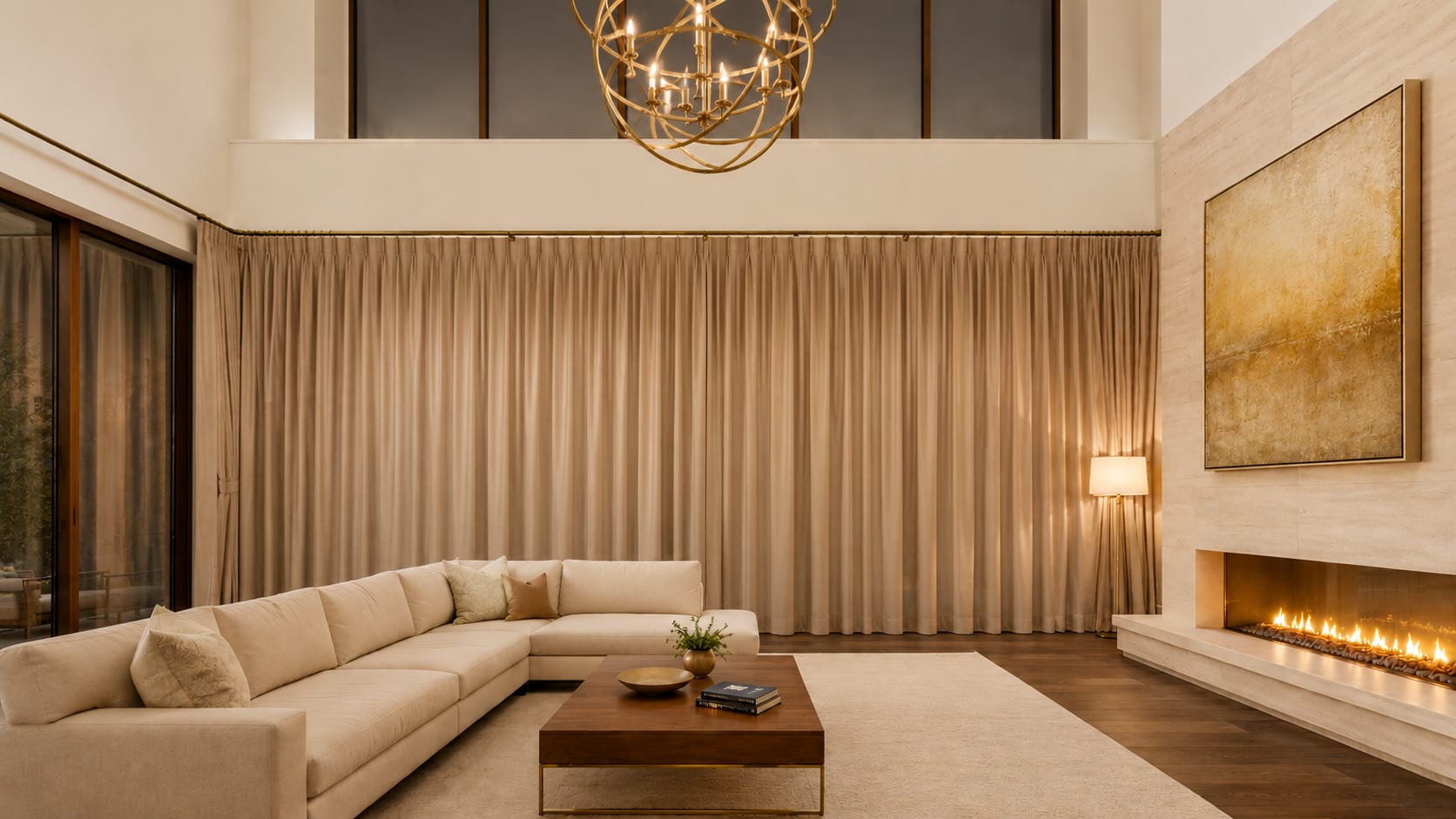
Drapery does something in a room that no shade does. It carries colour and texture down the full height of the wall, it softens the acoustics of rooms with a lot of glass and hard floor, and it gives an opening a finished edge that a shade alone always leaves slightly bare.
In most of the rooms we work on it is not either-or. A shade handles light and privacy; drapery handles the architecture.
Headings
Ripplefold produces a continuous, even wave with no pleat detail at the top. It is the cleanest contemporary option, it stacks tightly off the glass, and it is the most reliable heading for motorized track.
Pinch pleat — French, Euro, goblet — is the traditional, more formal treatment, structured at the top and tailored in appearance. It suits older Pittsburgh houses with substantial trim and high ceilings.
Grommet and rod pocket are simpler and more casual, better suited to a secondary room than a principal one.
Fabric and lining
The lining decides how the panel hangs and how long it lasts, and it is where inexpensive drapery gives itself away. A proper lining adds weight and body, protects the face fabric from sun degradation, and keeps the folds consistent along the whole drop. Interlining adds a further layer for insulation, acoustic damping and a heavier, more luxurious fall.
Full-height panels are hemmed to break or float at the floor to within a fraction, which is only achievable when the track is set and measured in place rather than estimated from the drawing.
Motorized track
Motorized drapery is where the product becomes genuinely effortless — a full wall of panels closing on a schedule at dusk, or opening with the morning scene. The track is the component that matters: it needs to be rigid, properly supported, and quiet under load, because a heavy interlined panel is a real mechanical demand.
We run drapery on the same control system as your motorized shades so a single scene moves both layers together.
Layering
The common arrangement in the houses we work in is a functional layer plus a decorative one: a solar or blackout roller shade doing the work at the glass, with drapery framing the opening and closing over it when the room wants to feel enclosed. In bedrooms, drapery over a blackout shade in side channels is the combination that actually delivers a dark room.
Common questions
- How long does custom drapery take?
- Typically several weeks from fabric approval, since panels are cut and finished to your measurements. Designer fabrics with long lead times extend that, which we flag before you commit to a selection rather than after.
- Can drapery be motorized?
- Yes, on a motorized track. Ripplefold is the most reliable heading for it. Panels can be specified to draw from one side or to part in the centre.
- Should the drapery touch the floor?
- A slight break or a float of around half an inch is the usual specification. Puddling is a deliberate, more traditional look. Panels that stop short of the floor are the one option that always reads as a mistake.
- Do I need drapery if I already have shades?
- You do not need it. But rooms with a lot of glass and hard surfaces often sound and feel unfinished without it, and drapery is usually what closes that gap.
Talk to us about your windows
Free in-home consultation. We bring the samples to you, measure properly, and quote in writing.