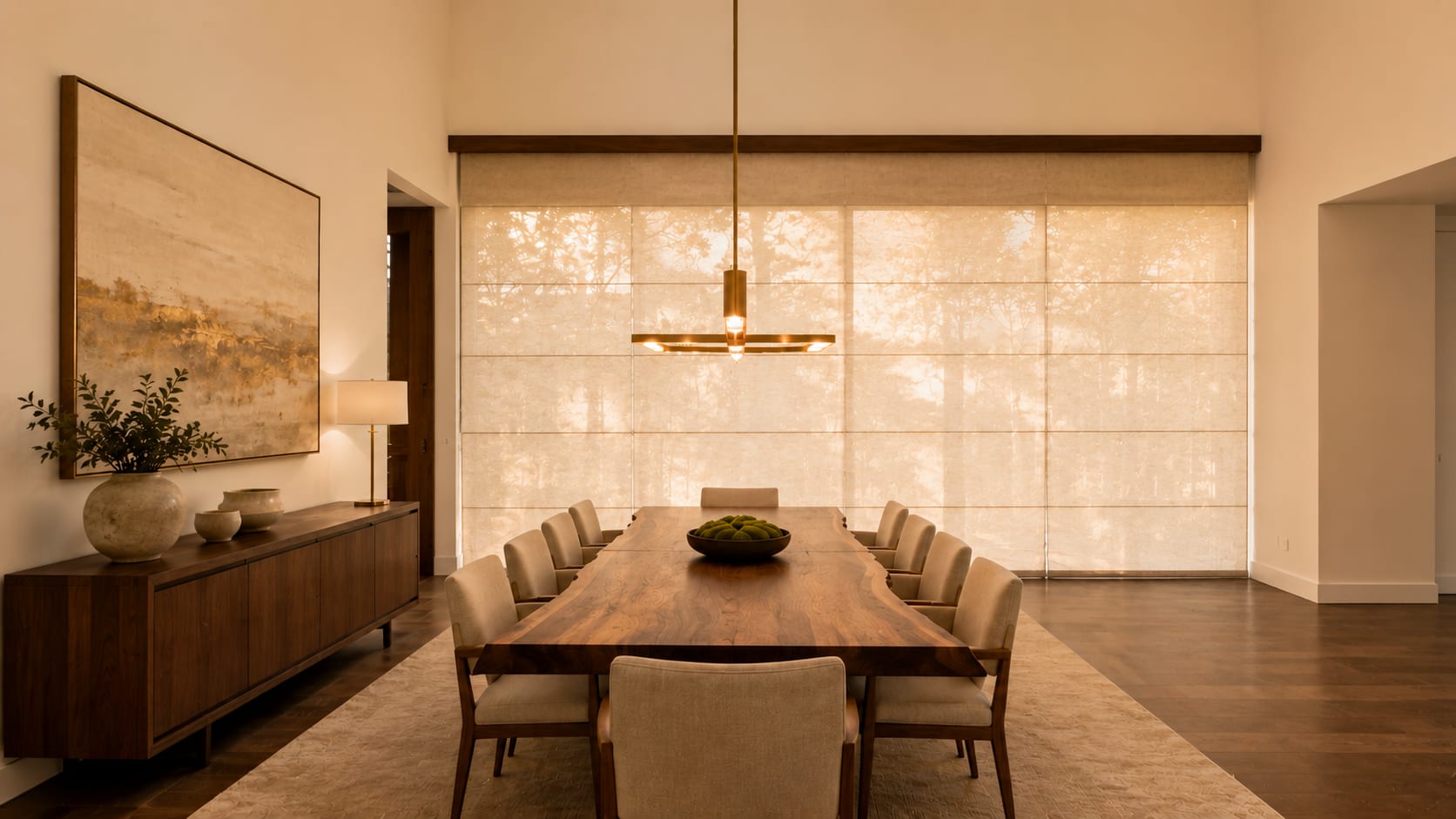
Roman Shades
The fabric of drapery, in the footprint of a shade.
A Roman shade folds upward into soft horizontal pleats rather than rolling onto a tube. That gives you the material quality and the tailored look of drapery in an opening that does not have the wall space for panels — which describes a great many dining rooms, kitchens and studies.
Lowered, it is a flat expanse of fabric. Raised, it stacks into an even, deliberate profile at the head of the window.
Styles
Flat fold is the crisp, tailored version — clean horizontal folds, structured, and the best showcase for a patterned fabric because the pattern stays readable.
Relaxed or hobbled styles introduce a gentle curve at the bottom edge or a continuous soft fold, producing a softer and less formal result.
Front-slat construction gives the sharpest, most architectural fold; a softer build reads more like fabric and less like joinery.
Lining
As with drapery, the lining does most of the work. A standard lining protects the face fabric and evens the light. Blackout lining takes a bedroom dark, though it is worth knowing that light will always find the small gaps at the sides of a Roman shade — for genuine darkness, a blackout roller in side channels is the more honest solution.
Interlining adds body and insulation, and gives the folds a heavier, more deliberate fall.
Motorization and safety
Roman shades motorize well and benefit from it more than most products, because the lifting effort on a large lined shade is significant.
There is a second reason, and it is not merely a preference. Since June 2024 the US window covering safety standard, ANSI/WCMA A100.1-2022, has applied to made-to-order custom products as well as stock ones, eliminating free-hanging operating and tilt cords. Roman shades sit squarely within its scope.
Where they work best
Dining rooms and studies, where the fabric is meant to be part of the room rather than a utility.
Kitchen windows above a run of counter, where drapery would be impractical and a bare roller would feel unfinished.
Mounted inside a deep reveal in an older house, where the shade sits within the joinery and the trim does the framing.
Common questions
- How much window do they cover when raised?
- The stack is typically several inches deep depending on the drop and the style. Mounting above the opening is the usual fix where you want the glass fully clear.
- Can Roman shades be blackout?
- With blackout lining they get most of the way there, but light will find the edges. For a truly dark bedroom we recommend a blackout roller in side channels, with the Roman or drapery over it for appearance.
- Are they cordless?
- Yes. We build cordless or motorized as standard, which is both the compliant specification and the sensible one in a house with young children — the US safety standard ANSI/WCMA A100.1-2022 has covered custom made-to-order products since June 2024 and eliminates free-hanging operating cords.
- Can I use my own fabric?
- Usually yes, subject to the fabric being suitable for the construction — weight, width and railroading all matter. We will tell you before the cut if a chosen fabric will not behave.
Talk to us about your windows
Free in-home consultation. We bring the samples to you, measure properly, and quote in writing.